The iHub platform is a key component of the system architecture that is designed to facilitate communication and data exchange between Single Online Home services and client forces. The platform leverages a Standard Data Model (SDM) to decouple forces from Single Online Home services, reduce variability in payloads, and to streamline the payload delivery channels. This makes it easier for downstream systems to integrate with the iHub.
When members of the public submit a Single Online Home (SOH) form, a JSON object is generated that contains all fields populated in the SOH form. This is referred to as a "digital report". This report is accompanied by a PDF version of the completed report, any media attachments from the member of the public, and a service information text file.
These are primarily made available to client forces the following mechanisms. While there are other mechanisms using custom integrations, these are not the templated approach and are outside the scope of this document.
The iHub receives "digital reports" from Single Online Home via an "Experience API". These reports are then processed through a series of API layers which perform the following functions:
- Experience APIs
- Consumes payloads from SOH services and performs schema and validation checks.
- Process APIs
- Transforms SOH payloads into a "Standard Data Model" and routes the payload to the correct System API .
- System APIs
- Maps and connects the payloads to client forces via one of two routes:
- Email Submissions
- "Standard API" Integrations
- Maps and connects the payloads to client forces via one of two routes:
This model can be seen below:
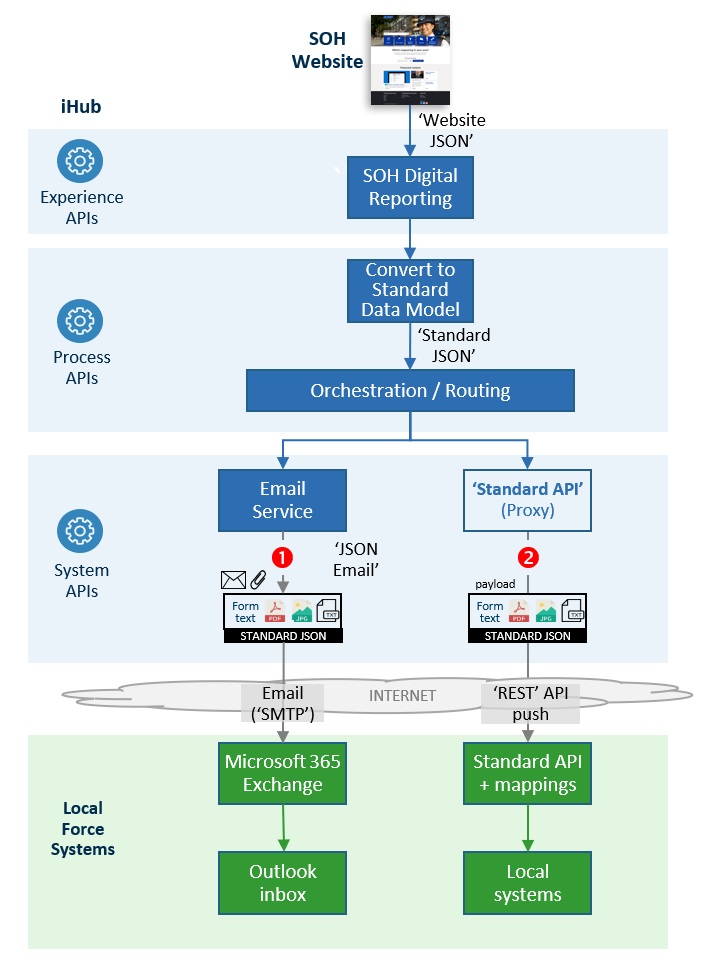
The methods of integration with client forces are elaborated on below.
Forces that opt to receive Standard Data Model payloads via an email will receive the JSON object as an email attachment from the iHub. This enables forces to receive the submission in a timely manner and use one data model to account for all supported Single Online Home services.
This integration service requires forces to host a RESTful API, henceforth referred to as "Standard API". This API should have a POST endpoint which the iHub can post requests to containing the SDM payload in a JSON format. Payloads will be contained in the body of the POST request.
This solution automates the transfer of data from Single Online Home to client force systems and enables forces to map this data directly into their local systems as required.
Standard API developed by forces should conform to the JSON:API specification. This defines how the client should format requests and how the server should format JSON responses.
JSON Document schemas will be documented using the JSON Schema specification (currently at version “draft 2020-12”) see https://json-schema.org/specification.html.
Media uploads can be attached to forms by members of the public when they submit them on SOH. Once uploaded, these attachments are made available to client forces via two separate mechanisms.
In both mechanisms, an Experience API on the iHub receives the media upload, where it then undergoes a data validation process and is routed through a series of API layers which perform the following functions:
- Experience APIs
- Consumes media attachments from SOH services and performs security and data validation checks on the uploads. This prevents uploading malicious content and limits the upload size to mitigate the risk of service disruption for other users.
- Process APIs
- Routes the media attachment to the correct System API.
In the first mechanism, media uploads are then made available to client forces by the following process:
- System APIs
- Maps and pushes the media upload to the client force's Digital Asset Management System (DAMS).
- AWS Services
- A URL to access the media attachment from the client force's DAMS is made available to the iHub via the System API layer.
Links to the media attachment are then provided to client forces via the following options:
- Email Submissions
- A URL link to the media upload will be included in the payload of the Standard Data Model. This payload will be sent over email.
- Standard API
- A URL link to the media upload will be included in the payload of the Standard Data Model. This payload will be sent via Standard API.
This first mechanism is only available for supported Digital Asset Management Systems (DAMS).
In the second mechanism, media uploads are processed in accordance with steps 1 and 2, the same as in option one. Media uploads are then directly made available to client forces via the POST to the Standard API:
- System APIs
- Makes the media upload available to be posted with the SDM payload (and all attachments) directly to the Standard API.
With this second mechanism, forces do not need to go to an external link to access the media upload, but will instead receive it directly with the JSON payload.