Standard Data Model (SDM) will be the standard adopted for all Single Online Home services that are integrated with the iHub. This is a JSON data model that is defined using a JSON schema.
By standardising all Single Online Home forms into one data model, variability in Single Online Home payloads is much reduced which enables forces to develop re-usable integrations.
Standard Data Model adopts a POLE-based model, a data model used for policing, investigations, and security use cases. This model is aligned to the National Police Chiefs' Council (NPCC) standards which follows a POLE model and has been produced to support the consistent and accurate recording of police operational information and data.
POLE focuses on four different types of objects and their relationships between each other:
- Person
- Object
- Location
- Event
Within each of these data objects, further objects can exist to their nature. For example, a person might be a "witness" or a "victim". A complete set of these sub-entities are presented below:
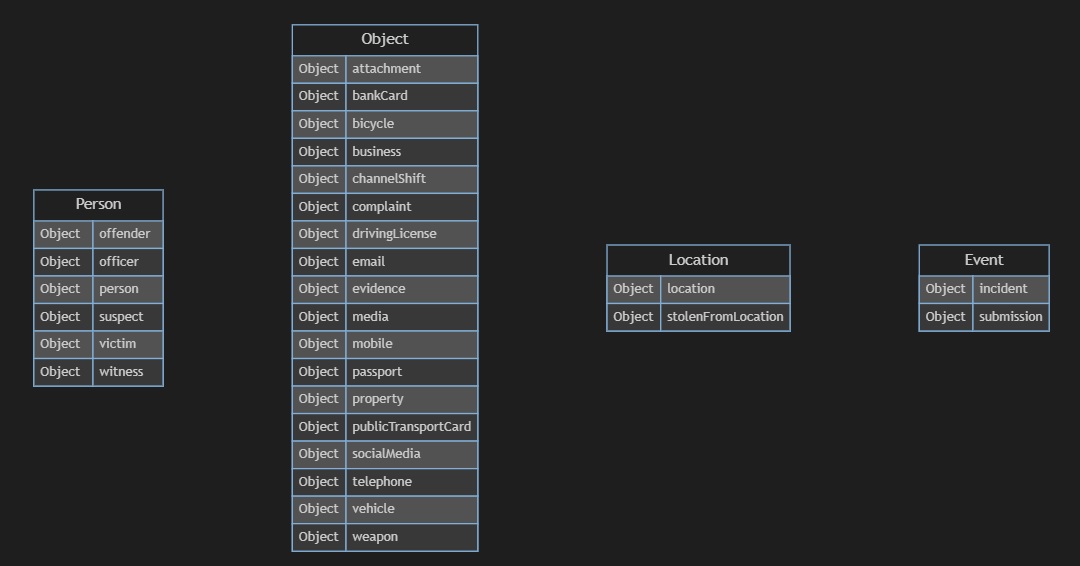
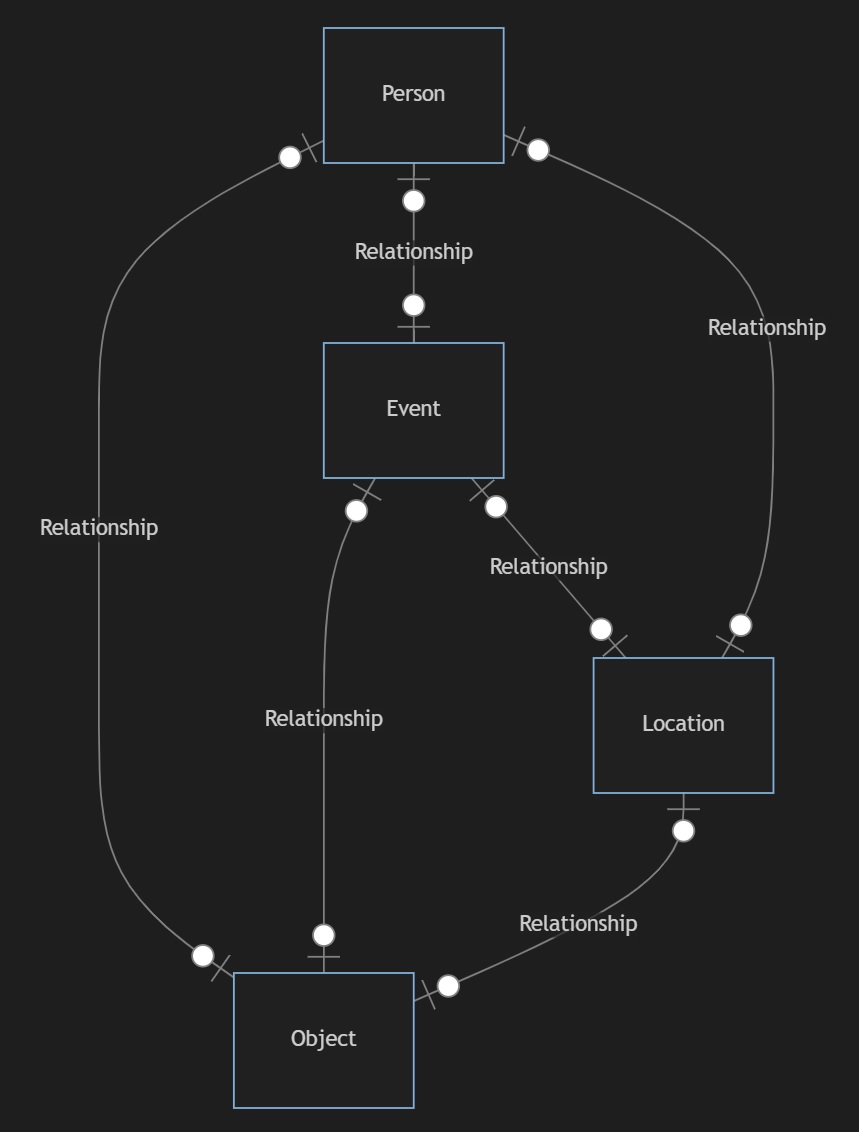
Relationships describe the connection between each POLE object. For example, the relationship between a "person" and an "incident" might be "witness". Relationships can only be one-to-one; if there is more than one relationship between objects, separate relationships are required. For example, if a "Person" and an "Incident" relate to each other as both the "witness" and the "personReporting", separate relationships are required.
The diagram below demonstrates this model:
A list of all relationships that exist within the POLE standards and SDM model can be found in section 3.1.
With these features, Standard Data Model offers the ability to work with data in a granular and interconnected way. Using an "online crime report" as an example, we can see below what all the POLE objects are and how they're related:
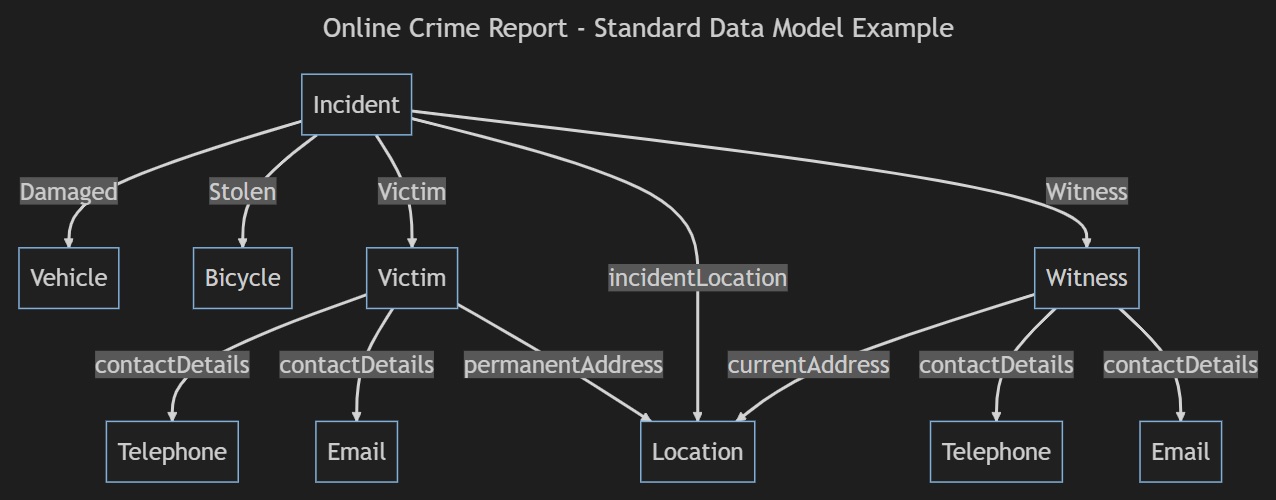
Compared to legacy integrations, we can see how relationships between each of the objects aren't as clear or interconnected. Further, they differ by Single Online Home service.
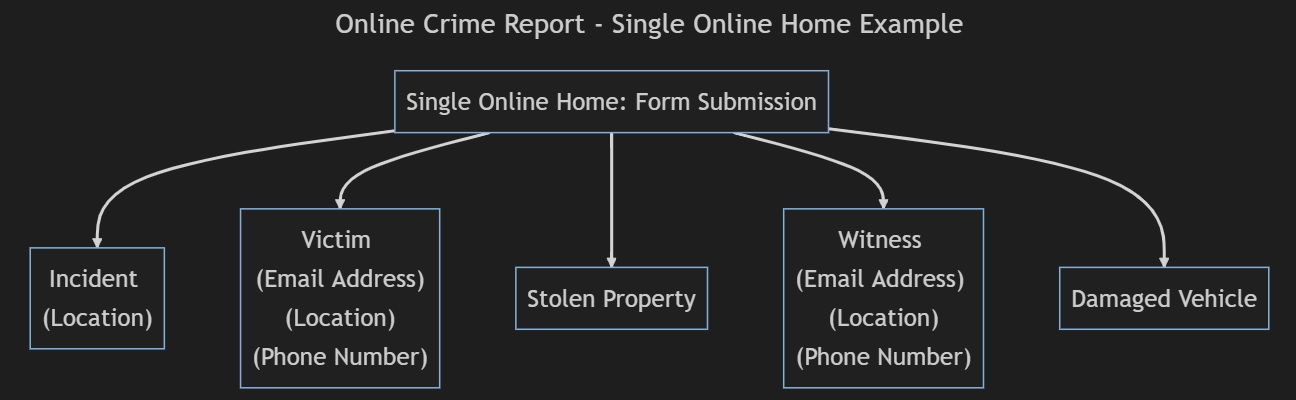
Example JSON objects can be found in each of the below sections:
- Section 3.2: Standard Data Model - Online Crime Report JSON Object Example
- Section 3.3: Single Online Home - Online Crime Report JSON Object Example
Mappings from Single Online Home services to the iHub's Standard Data Model are unique per service. Mappings for each supported Single Online Home service can be obtained through the iHub team.
The iHub restricts some Standard Data Model fields to a set of pre-defined outputs. These are known as Constrained Values (CVs), otherwise known as ENUMs. The purpose of these restricted values are to normalise the data and maintain data quality.
All Constrained Vocabulary (CV) identifiers correspond to a defined format. They use uppercase SNAKE_CASE and follow the below format:
- [Code]_[Identifier]
- E.g. "ACNT_0001"
The "Code" is a 4 character identifier based, where possible, on the name of the constrained value list. This code will be alpha-only. For example, "CTRY" for the Country CV list.
The "Identifier" is a unique, alphanumeric value, where that attribute will be either:
- Defined by an existing standard (e.g. ISO3166 country codes "GBR" and "USA").
- A four-digit, padded, self-incrementing integer where the standard has been internally developed by the programme. These identifiers are initially created by sorting the CV list display texts alphabetically and allocating integers in sequence.
A full list of all CVs can be found in section 3.3 here.
All data objects that pass through the iHub are defined by a strict JSON schema. Details of this can be found within section 5.2 of the DPC API Technical Data and Documentation standards.